












What is Digital Immune System?
Digital Immune System: Building Self-Protecting Digital Environments
Introduction to the Digital Immune System
Today’s digital systems are constantly under pressure from server overloads, software faults, cyberattacks, and unplanned breakdowns. Manually controlling these hazards is akin to using a bucket to halt a flood. The Digital Immune System (DIS) alters the rules in this situation.
Similar to how the physical immune system defends the body without conscious effort, a digital immune system enables apps and IT infrastructure to identify issues early, react quickly, and recover automatically.
Put simply, it aids in the self-defense of digital systems.

What Is a Digital Immune System?
A Digital Immune System is a modern framework that combines:
-
Artificial Intelligence (AI)
-
Machine Learning (ML)
-
Automation
-
Advanced monitoring and analytics
Reducing system failures, preventing cyber risks, and maintaining continuous performance often without human involvement are its goals.
A DIS concentrates on prevention, prediction, and self-healing, in contrast to conventional security technologies that only respond when harm is done.
Why the Digital Immune System Is Gaining Importance
Technology stacks are becoming more complex every year. Cloud services, APIs, microservices, and remote users increase the attack surface dramatically.
Key reasons businesses are adopting DIS include:
-
Rising cybercrime
-
Higher downtime costs
-
User demand for 24/7 availability
-
Faster software release cycles
According to modern cybersecurity trends, reactive defense is no longer enough. Systems must become intelligent and adaptive.
From Traditional Security to Digital Immunity
Limitations of Traditional Cybersecurity
Traditional cybersecurity relies heavily on:
-
Static rules
-
Manual intervention
-
Post-incident investigation
This approach struggles with:
-
Zero-day attacks
-
Complex cloud environments
-
High alert fatigue
The Shift Toward Self-Healing Systems
A Digital Immune System focuses on continuous learning. Every failure, attack, or anomaly becomes a lesson that improves future responses.
Think of it as antivirus software that evolves daily instead of yearly.
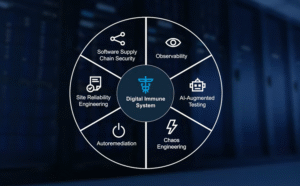
Core Elements of a Digital Immune System
Advanced Observability
Observability goes beyond logs and metrics. It provides deep insight into system behavior, allowing teams to understand why something is happening, not just what happened.
AI and Machine Learning Intelligence
AI analyzes massive datasets to:
-
Identify abnormal behavior
-
Predict system failures
-
Detect hidden security threats
Learn more about AI-driven security:
https://www.ibm.com/topics/artificial-intelligence-cybersecurity
Automation and Self-Repair
Automation enables systems to:
-
Restart failing services
-
Block suspicious traffic
-
Roll back faulty updates automatically
Predictive Risk Identification
The system identifies risks before they turn into outages.
Automated Recovery
Problems are resolved in seconds—often before users notice.
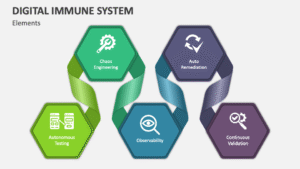
How a Digital System Operates
Detection Phase
Continuous monitoring identifies unusual activity across applications, networks, and users.
Analysis Phase
AI determines whether the issue is a bug, attack, or performance anomaly.
Response Phase
Automated actions are triggered immediately to reduce impact.
Learning Phase
The system stores insights to improve future decisions.
Each cycle makes the system stronger.
AI’s Role in Strengthening Digital Immunity
Smarter Threat Recognition
AI detects patterns that humans often miss, especially in large-scale systems.
Lower False Alarms
Traditional tools overwhelm teams with alerts. AI reduces noise and highlights real threats, improving efficiency.
Explore Microsoft’s AI security approach:
https://www.microsoft.com/security/business/security-ai
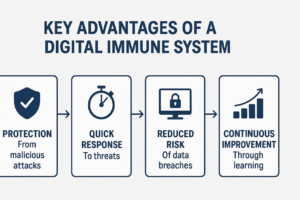
Key Advantages of a Digital Immune System
Higher System Stability
Applications remain available even under stress.
Reduced Operational Costs
Less downtime means fewer revenue losses.
Improved Security Confidence
Organizations gain confidence knowing threats are handled automatically.
Digital Immune System vs Traditional Security
| Aspect | Traditional Security | Digital Immune System |
|---|---|---|
| Threat Handling | Reactive | Predictive |
| Response Speed | Slow | Instant |
| Learning Ability | None | Continuous |
| Downtime Impact | High | Very Low |
What is Digital Immune System?
Real-World Applications of Digital Systems
Cloud Platforms
Ensures uptime and auto-scaling during failures.
Banking and Finance
Protects transactions and detects fraud early.
https://www.cloudflare.com/learning/security/what-is-cybersecurity/
Healthcare Technology
Maintains availability of critical systems and protects patient data.
Online Businesses
Prevents revenue loss during traffic spikes or cyberattacks.
Challenges in Adopting a Digital Immune System
Initial Investment
Advanced tools and AI platforms require upfront costs.
Technical Expertise
Organizations need skilled professionals in AI and DevSecOps.
Privacy and Compliance
Handling large datasets requires strict data governance.
Digital Immune System Architecture Explained
Main Layers
-
Monitoring & Telemetry
-
Intelligence & Analytics
-
Automation & Response
-
Feedback & Optimization
Compatibility with Existing Systems
DIS integrates smoothly with DevOps and cloud-native environments.
Best Practices for Implementation
Build Strong Visibility First
Without observability, immunity is impossible.
Automate Wherever Possible
Human reaction time is too slow for modern threats.
Continuously Test and Improve
Chaos engineering and simulations strengthen resilience.
The Future of Digital Immune System
Self-Managing Enterprises
Businesses will rely on autonomous IT systems.
Beyond Zero Trust
Digital immunity complements Zero Trust with real-time self-defense.
https://www.nist.gov/cyberframework
Here you can explore more about the Cyber security and how it works…
Popular Tools Supporting Digital Systems
| Tool | Primary Use |
|---|---|
| Dynatrace | AI observability |
| Splunk | Data & security analytics |
| New Relic | Application monitoring |
| Palo Alto | Automated threat response |
Why Digital Immune System Are No Longer Optional
Downtime damages trust. Security breaches destroy reputation. In a digital-first economy, resilience equals survival.
A Digital Immune System provides:
-
Speed
-
Intelligence
-
Reliability
It’s not a luxury—it’s a necessity.
Conclusion
A significant advancement in the preservation and security of digital environments is the Digital Immune System. Organizations may create self-defending, quickly recovering, and continuously improving systems by integrating AI, automation, observability, and continuous learning. Digital systems need to adapt to the increasing sophistication of cyber attacks.
FAQs
1. Is a Digital Immune System the same as cybersecurity software?
No. It enhances cybersecurity by adding automation and self-healing capabilities.
2. Can small businesses use a Digital Immune System?
Yes, especially cloud-based solutions designed for scalability.
3. Does a Digital Immune System replace IT teams?
No. It supports teams by reducing manual workload.
4. How long does implementation take?
It depends on system complexity, but adoption can start gradually.
5. Is AI mandatory for a Digital Immune System?
Yes. AI is the core engine that enables prediction and learning.
Please don’t forget to leave a review, And share about your thoughts here.











Recent Comments